
Why I Launched ai4sme.org
Why I Launched ai4sme.org
We have evaluated more than a thousand companies for AI projects across the programmes I built and led at AI Singapore: 100E, LADP and SIP. Three hundred and fifty of them became projects. That is thirty-five percent, and the other sixty-five percent is the interesting part. Those companies raised their hands on their own, and what turned them away was rarely the technology. It was readiness: data that was not ready, a leadership team that was not aligned, a problem nobody had defined.
The projects themselves almost never fail, because we curate before we approve: data and infrastructure are verified before a project starts, and every project has reached signoff except one, which we terminated. Around thirty percent of completed projects do not deploy, and the cause usually traces to leadership and culture.
A quarter of the three hundred and fifty projects went to SMEs, and the SME picture is the reason ai4sme.org exists. We have assessed more than five thousand organisations with AIRI, the AI Readiness Index I created in 2019. The chart below plots every assessment by company type and industry, with each block sized by the number of companies and coloured by its average AIRI score.
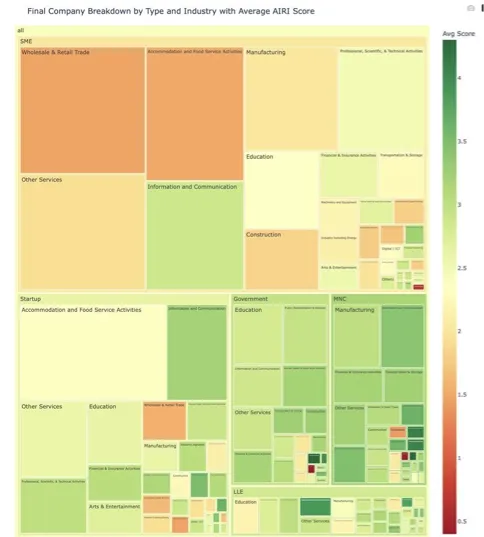
The SME band is the largest on the chart, and it sits at the low end of the scale. Startups, government agencies and multinationals sit higher. Most organisations that assess sit below AI Ready, Level 2, and Level 2 is where the economics start to work for a business your size. Below it, you are paying for tools nobody uses well. Most SMEs can reach Level 2, and almost none should go further: Level 3 means funding an AI team whose salaries most SMEs cannot carry and, in my experience, do not need to.
The method was never the problem. The queue was.
For nine years I built and led the national AI programmes at AI Singapore: 100E for industry projects, the AI Apprenticeship Programme for talent, AI For Everyone for literacy, AIRI for measurement. The law those programmes taught is short. Assess readiness before you build. You do not skip the level you are on.
The method lived inside programmes with queues: application forms, co-funding cycles, steering committees. A multinational can queue. An SME owner cannot. The owner can decide on Friday and start on Monday. The blueprint we wrote was national-programme-sized. The demand arriving now is person-sized, and it deserves a door with no queue.
The second attempt, this time without the committee
I have tried the multilateral route. In 2021 a working group I led under the Global Partnership for Artificial Intelligence (GPAI) built the first version of an SME AI portal, with AIRI as its readiness instrument; it went live in Singapore, Serbia, Poland and France, and it did not scale. GPAI folded into the OECD in July 2024, and in September this year I formally closed that chapter. Rather than wait for the OECD to pick it up, I put the method on a website I run myself.
ai4sme.org is live. It is a personal initiative, independent of AI Singapore, and everything on it is free.
- Assess: the AIRI assessment, fifteen minutes, no account. It has two halves: the organisational half, answered independently by three to five senior leaders, and the personal half for your people. Run both, because the gap between them is itself a finding. The emailed report names six AI use cases already running in your industry.
- Download: the SME AI Deployment Guide, as one printable workbook. Ideate, map, score, decide, build or buy. One email, no account or login required.
- Learn: a 14-lesson course, about three hours, full text plus my own narration. No login, no quizzes, no grant funding required.
- Browse: a library of 308 documented AI use cases across 25 industries, so nobody starts from a blank page.
The AIRI Decision Engine in the SME AI Deployment Guide is the part I would keep if I could keep only one thing. You score two candidate projects on the five AIRI pillars. Leadership counts double, because that is where projects stall. Data counts more than infrastructure, because you cannot rent your own data. Ethics is a gate: fail it, and the score is halved or zeroed. The first project is the one with the highest AIRI Decision Score. The project with the lower score is not dead; it is next in line, with its weakest pillar named, which allows you to improve the pillar.
Then the register. The score is written at inception and never changed, and beside it, checkpoint by checkpoint, achieved revenue or savings at day 1, day 90, month 6, month 12, month 18. What counts is strict: the model runs in your systems or it does not count, and a notebook demo does not count. One running workflow that survives staff turnover is worth five pilots that died in demonstration.
The pathway I recommend to most SMEs is train-your-own-staff: your curious technical employee, a real problem from you, about a month of scoping and a month of mentored build on your own data, with the intellectual property yours. Across that programme, roughly six to seven in ten projects reach deployment.
Why now
Three reasons.
First, we have already seen the demand. More than a thousand companies came forward on their own, and readiness turned two-thirds of them away. That is not a survey projection. The queue formed on its own, and ai4sme.org is built for the two-thirds as much as for the three hundred and fifty. Assessing first saves you six months of the wrong projects.
Second, agentic AI raised the floor. Two years ago I said AI Aware on the AIRI ladder was a reasonable resting point for a small firm. Agentic tools changed that: AI Aware is now table stakes. For most SMEs the destination is now AI Ready, and the site says it plainly: AI Ready (Level 2) is the success target, not a consolation prize.
Third, the world caught up with the method. AIRI has been adopted by companies and countries including Serbia, the first foreign adopter in 2021, then Malaysia, France, Germany and Poland. The OECD’s current adoption recommendations read like the project and report we completed in July 2024. The method no longer needs a committee. It needs a URL.
The launch
The method used to sit behind an application form. I have taken the application form away. Fifteen minutes at ai4sme.org tells you where you stand, the guide tells you what to do about it, and the project tracking register keeps you honest for eighteen months. There is nothing to buy. No grant to apply for. Everything here is free. Your email and your time are all that is required.
Assess, read, engage at ai4sme.org.
Sources: all figures are from the AI Singapore programme records: the 100E, LADP and SIP evaluation funnel (companies evaluated, projects started, SME share), AIRI assessment results across more than five thousand organisations, and the project outcome records (signoff and deployment outcomes). The company breakdown chart is generated from the AIRI assessment corpus.
- AI4SME
- SME
- AIRI
- AI readiness