
Teaching AI at a Hokkien Mee Stall: Why I Built hokkien.me
Teaching AI at a Hokkien Mee Stall: Why I Built hokkien.me
One slide in my 2021 AI For Everyone decks always got a laugh: “Firstly we have to decide what we want to cook, and today I am in the mood for hokkien mee. Similarly, we need to identify the business problem we want to solve.”
Five years on, the joke has its own website. It went live last weekend. hokkien.me teaches AI through one Hokkien Mee stall: 21 lessons of about three minutes each, free, no sign-up, a transcript on every lesson, about an hour end to end. Read it, or listen to it.
Why a hawker stall
I built AI For Everyone at AI Singapore; more than 300,000 people have taken it. But AI4E is workplace-shaped: business problems, return-on-investment slides, case studies from banks. That framing was right for its audience, and it is wrong for the audience AI now has.
AI has left the workplace. It is in the homework, in the family group chat, in the scam call that sounds like a nephew. When a technology reaches the eight-year-old and the eighty-year-old, the explanation cannot stay workplace-shaped. It has to happen somewhere everybody already sits down, and in Singapore that place is a hawker counter.
The course maps every concept onto the making of one plate of noodles. The wet market is data collection. The sink is data cleaning. The prawn stock is feature engineering, the wok is training, tasting is evaluation, and the plate going out is deployment. The empty plates that come back are the feedback loop. The chef who plans the whole service, watches the queue and re-fires when the squid runs out is an agent. The lesson on the sink ends with the line I would print on a T-shirt. Most projects are not lost at training. They are lost at the sink.
The host is a plate of noodles
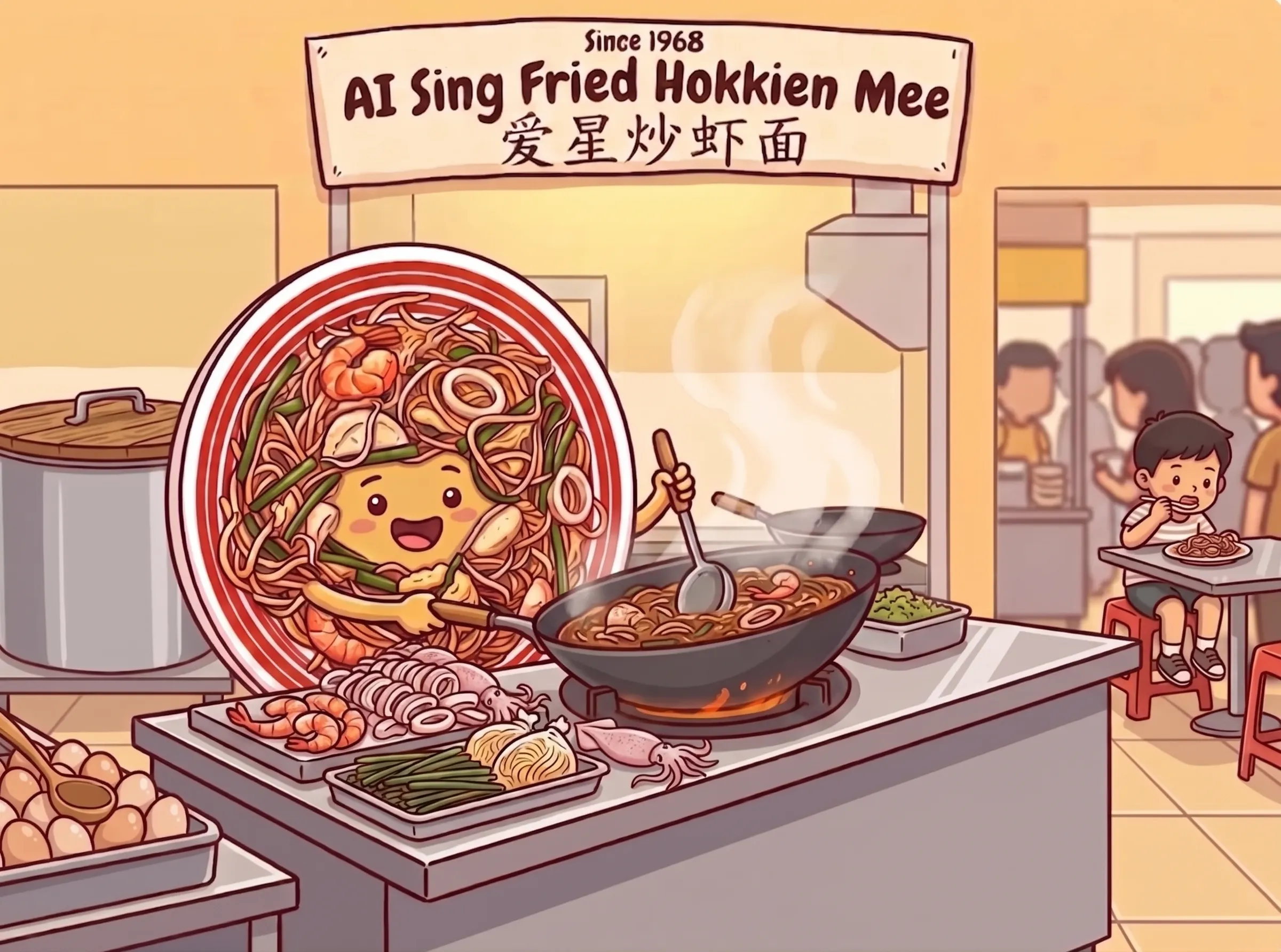
AI Sing, the host, is a cheerful plate of Hokkien Mee who has run his own stall since 1968. The name plays on AI Singapore and the “Sing” in real stall names, and he is spoken as “Eye-sin”. He is not an AI, and the site says so plainly. The course is equally careful to say where the analogy ends: where the noodle story stops, the lesson stops too and names the real thing.
The audience line on the site is ages 8 to 80, and the writing took that literally. The reading level was deliberately brought down to a young-teen band, because the youngest reader at the counter sets the pace. The finale lesson is called “Explain it to Ah Ma”: the test of the course is whether, after an hour at the counter, you can explain AI to your grandmother over dinner, in your own words.
How it was made, the honest version
The site carries an honesty line: taught by a hawker, written by a human. Here is the fuller version, because the how is half the point.
The lessons were written to a strict specification: five beats each (hook, concept, example, try, takeaway), about 150 words a minute, Standard Singapore English rather than Singlish, and not one line of code. Then the whole corpus went through a Singapore-English pass run by SEA-LION, the Southeast Asian language model family built at AI Singapore, which diagnosed and reworked the Americanisms. It edited 13 of the 21 lessons. The corpus was already about ninety-five percent there. Write the first draft carefully, and the regional model combs the text rather than rewriting it.
Every lesson is narrated word for word in a clone of my voice, made with ElevenLabs. It is the same voice that taught AI4E. I did not spend a week in a recording studio. The narration is generated from the lesson text, reviewed, and published.
The art is where I changed my mind. I generated the lesson posters with image models first via the automated pipeline, but it could not hold the consistency. So in the end I had to manually generate each image in a Google Gemini Pro chat window.
The site itself is static. No login, no tracking, your progress kept in your browser and nowhere else. It costs almost nothing to serve, which is why it is free and will stay free. This is eating our own dog food, and it shows what a strict specification and these tools now put within reach of one person.
Why now
Because the questions arrived at home before the explanations did. Marketing now puts the vocabulary of models and agents on the dinner table faster than the schools do, and a family that understands the concepts makes better decisions than one that does not.
The course also spends a whole lesson on when to trust the machine, and the rule it teaches is the one I give bosses too. When a decision is small and reversible, the agent runs on autopilot. When it is big or public, you sign off. Trust follows stakes. An eight-year-old can hold that rule, and so can a board.
Pull up a stool at hokkien.me. The first plate is on the house. And if, after an hour at the counter, you can explain to Ah Ma what a model is and why the sink matters more than the wok, the course has done its job.
P.S. from the counter: business has been good, so on Tuesday we are opening a second stall, this one for the boss. Same hawker centre. Watch this space.
- AI literacy
- AI4E
- hokkien.me