
The Forward Deployed Engineer and the AIAP Graduate: Where the Gap Is
The Forward Deployed Engineer and the AIAP Graduate: Where the Gap Is
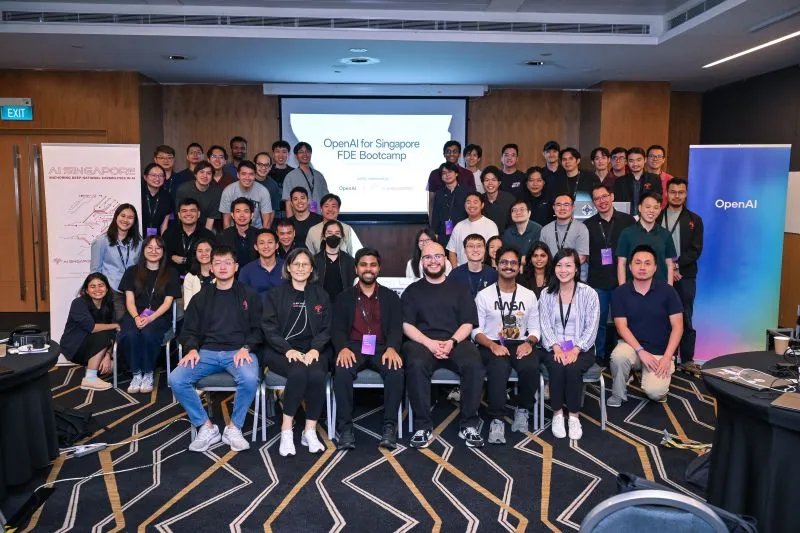
This week AI Singapore and OpenAI wrapped up the OpenAI for Singapore FDE Bootcamp. Three days, hands-on, co-organised with OpenAI. My AI engineers and apprentices spent those three days building, and the bootcamp showed us what an FDE does from the point of view of a frontier lab. They met the standard expected of them.
Afterwards, everyone asked me the question I had opened with on LinkedIn: what exactly is an FDE, a forward deployed engineer, and what do they do?
What an FDE actually does
Palantir made the role famous. Ted Mabrey, who ran Palantir’s global commercial business, called the forward deployed engineer model “one of our greatest secrets” in a 2023 interview. The engineer lives at the coalface with the customer and owns whether the software actually works. A sales engineer demonstrates the product and flies home. The FDE stays until the system runs in production.
The title has spread across the AI industry, and OpenAI is now hiring for it in Singapore. The careers listing describes the work plainly: own technical delivery across multiple deployments, from first prototype to stable production, and build full-stack systems for strategic customers, leading end-to-end deployments of frontier models in production. The same listing asks for at least five years of engineering or technical deployment experience, customer-facing work included.
Singapore saw the shape of this in May, at the ATx Summit. OpenAI for Singapore is a multi-year commitment of more than S$300 million, with over 200 technical roles and OpenAI’s first Applied AI Lab outside the United States. It includes a forward deployed engineer training programme to grow local AI deployment talent. The three-day bootcamp my team just attended is that programme made real.
We have been growing them since 2018
Read that job description to an AIAP apprentice. It will sound familiar.
The AI Apprenticeship Programme (AIAP) exists because in 2017 I could not hire AI engineers. Over 300 resumes came in. Ten were Singaporeans. I hired one. So we stopped competing for ready-made talent and started growing our own. The entry criteria were Singapore citizenship, a technical test, and an interview. No computer science degree required.
Nine months, full-time. Three months of deep skilling, then six months on a real project. The projects are real because the money is real. A 100 Experiments (100E) sponsor co-invests SGD 150,000, and the average project runs to about SGD 300,000. Nobody spends that to host an intern. The apprentice faces messy data, demanding stakeholders, requirements that move mid-project, and a fixed horizon. The work ships in containers, behind APIs, into the sponsor’s own systems. Never a Jupyter notebook.
That is forward deployment. It always has been. More than five hundred engineers have come through the programme. We never used Palantir’s title. Around fifty percent hold a job offer before the programme ends, and more than ninety percent are working in an AI role within three months of graduation.
Eighty percent of them are not computer science graduates. They arrive from economics, psychology, biology, engineering. The FDE world calls that domain adaptability and treats it as a hiring criterion. We were selecting for it before the term was fashionable.
Where the AIAP graduate falls short
Three days of building with OpenAI’s engineers showed us the bar from inside a frontier lab. That view left me with three honest gaps.
The first gap is software engineering mileage. OpenAI asks for five years of it. The AIAP graduate has nine months of full-time AI engineering, plus whatever career they arrived from. Many are mid-career professionals with serious work behind them, but the years of writing and maintaining production code are missing. The gap is not AI capability. It is software engineering mileage.
The second gap is the frontier stack. AIAP was designed in 2018, when production AI meant classical machine learning. The curriculum has moved with the field, and our teams ship large language model products today. Still, an FDE inside a frontier lab works with the lab’s own machinery: evaluation harnesses, agents, retrieval, the specific failure modes of the models being deployed. That bar is higher than what a single sponsor project demands.
The third gap is posture. The apprentice delivers inside a team, with a mentor, a project manager, and senior engineers around them. The FDE stands in front of the customer alone and owns the outcome end to end. Our apprentices meet stakeholders every week, but the buffers are real. That kind of ownership cannot be taught in a classroom. It has to be lived.
What I am taking back to the programme
I wrote that the bootcamp will help us refine AIAP so more graduates land FDE roles. The refinements under discussion are straightforward. More frontier-stack engineering in the deep-skilling months: evaluation, agents, retrieval, deployed against frontier models and not only classical machine learning. Earlier solo ownership of the customer relationship in the project phase, with the mentor stepping back sooner. And honesty about time. No nine-month programme manufactures five years of production engineering. We will say so to every hiring manager who asks, and we will keep the software engineering bar high.
Every frontier lab setting up in Singapore is hiring the same profile: an engineer who can stand inside the client’s systems and make the model work, alone. Imported seniors alone will not fill 200 roles, and the pipeline that can has been running since 2018. It needs a frontier-lab polish, and after this week I know exactly where to apply it. The FDE wave is the market catching up with the apprenticeship model. The answer to 200 FDE roles is the answer I gave in 2017. Grow our own timber.
Sources
- Laurence Liew, LinkedIn post on the OpenAI for Singapore FDE Bootcamp (9 October 2026): linkedin.com/feed/update/urn:li:activity:7514290284671877120
- OpenAI, “Introducing OpenAI for Singapore” (19 May 2026): openai.com/index/introducing-openai-for-singapore
- Stratechery, “An Interview with Palantir CTO Shyam Sankar and Head of Global Commercial Ted Mabrey” (15 June 2023): stratechery.com/2023/an-interview-with-palantir-cto-shyam-sankar-and-head-of-global-commercial-ted-mabrey
- OpenAI careers, Forward Deployed Engineer (Singapore) listing: openai.com/careers (the five-years requirement is as mirrored on LinkedIn and Glassdoor, October 2026)
- AIAP placement, intake and 100E project figures: AI Singapore programme records, operator rulings of 18 July and 18 September 2026
- FDE
- AIAP
- AI talent
- OpenAI
- AI Singapore