
Dog Tags, Not Birth Certificates: The Year AI Agents Got ID Cards
Dog Tags, Not Birth Certificates: The Year AI Agents Got ID Cards
In January, McKinsey’s global managing partner, Bob Sternfels, put his firm’s workforce at 60,000. Forty thousand are people. Somewhere between 20,000 and 25,000 are AI agents, by his two most recent counts, and his stated goal is one agent alongside every consultant (Business Insider, 12 Jan 2026).
The rest of the year piled on. Cato Networks, a security company, wrote in February that “AI agents aren’t applications. They’re employees.” Marc Benioff told the World Economic Forum in 2025 that this is the last generation of chief executives who will manage fully human workforces. Jensen Huang says agents will go through recruitment, onboarding and training, with IT becoming their HR department. Sam Altman calls today’s agents junior employees. And in October, Beijing began a pilot that issues identity cards to AI digital humans: a virtual idol named Yuri received one carrying her name, birthday, address and facial features, which let her operators open a digital-currency wallet for her business (ABC News, 7 Oct 2026).
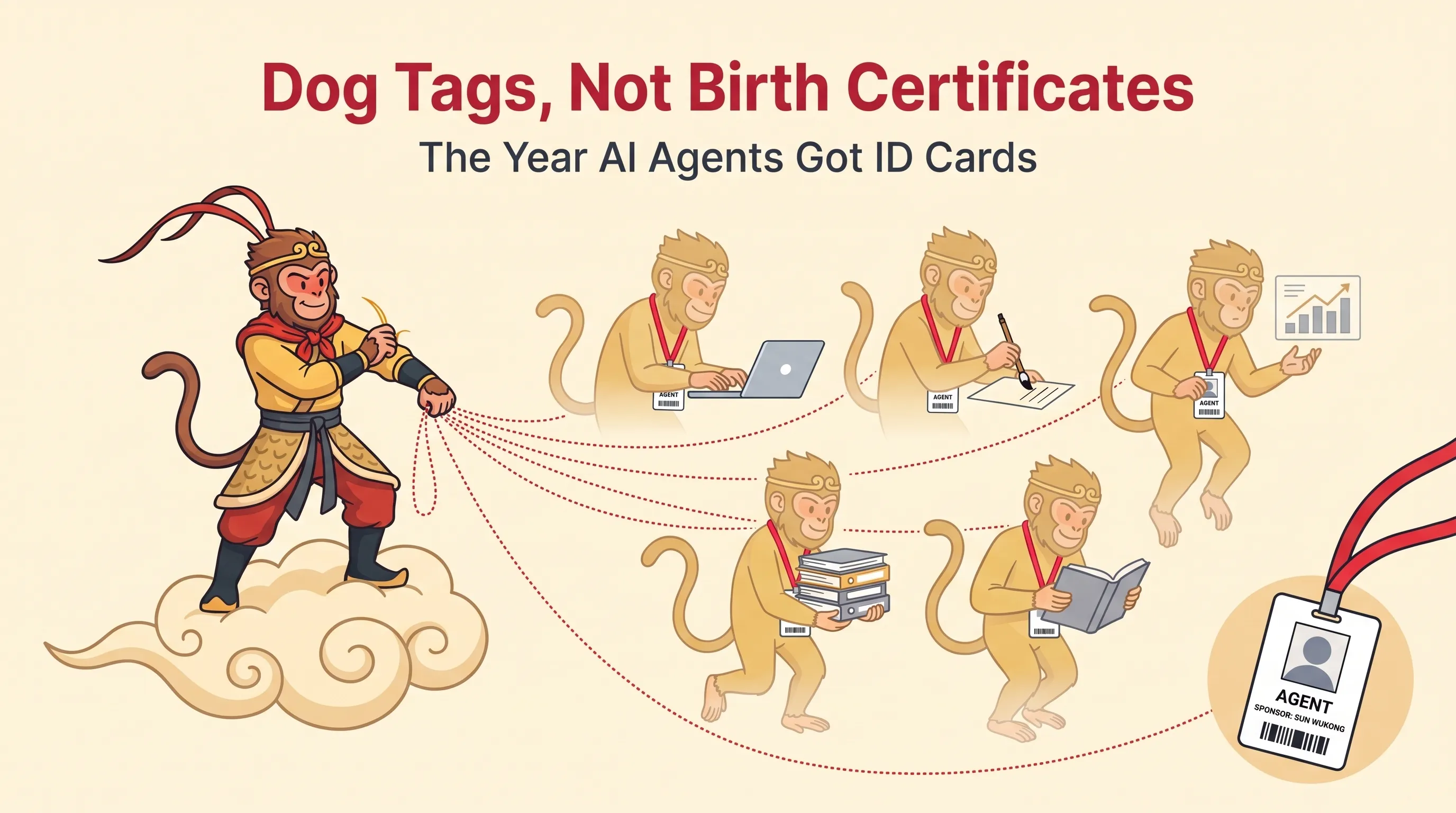
I have skin in this argument. In June I retired my Avengers slide and replaced it with the Monkey King. Sun Wukong does not recruit a team when one body is not enough. He plucks hairs from himself, turns them into clones, sends them to do the work, and takes them back when it is done. The clones hold no identity, no careers, no ambitions and no standing in any organisation, I wrote. Nobody runs a performance review for a plucked hair.
The past few months read like the industry lining up to prove me wrong. Agents have headcount at McKinsey, identity cards in Beijing, and accounts inside Microsoft 365. So before conceding anything, I did the boring thing and read the documentation. The headlines say employees. The documentation, almost everywhere, describes a dog tag.
What Microsoft actually wrote
Microsoft Entra Agent ID is the identity system at the centre of this story. Every agent built in Copilot Studio gets an identity in the tenant at the moment it is created, with the person who created it recorded as its sponsor (Microsoft Learn). That much is true; it is why you keep hearing that agents now have Microsoft accounts.
Then you read why the identity exists, in Microsoft’s own words:
“An agent might exist for minutes during a specific task, or might be created and destroyed thousands of times per day as part of an automated workflow.”
“The identity model is designed for scale and ephemerality rather than permanence.”
“Agent identities represent software systems, not human beings.”
Organisations can create these identities in bulk and retire them “without leaving orphaned credentials or permission assignments behind.” An identity that exists so software can be spawned by the thousand, tracked while it runs, and dissolved cleanly at the end of the task, with a human sponsor on record throughout. Microsoft could not have written the spec for Wukong’s hairs better if I had sent them the slide.
Where an agent genuinely needs to look like a person, because some corporate systems only talk to staff accounts, Microsoft lets it pair with a special user account. The account is a costume for legacy software, kept deliberately separate from human identity.
The headband, shipped as a product
In June I called governance the golden headband: engineering constraint, specified in advance, that tightens when the agent misbehaves. I argued it was a mistake to manage agents like employees, and correct to govern them like powerful tools. The identity industry spent this year agreeing with me, commercially.
Okta, which sells identity management, made its agent identity product generally available in May. It discovers unregistered shadow agents, assigns each one a named human owner, and enforces policy, with a kill switch at the end of it (Okta). Okta’s 2026 survey found that only thirty-four percent of organisations apply the same security controls to their agentic labour force as they apply to the human one (Okta, AI Agents at Work 2026). That number is the sales pitch, and what it sells is ownership, least privilege, audit trails and a way to switch the thing off. Even Cato, which uses employee language, ends its pitch in onboarding controls, least privilege and offboarding: a lifecycle policy for software, whichever nouns it dresses it in.
A contrarian camp is growing too. In February, Owen Williams wrote that calling agents employees is a category error, because an employee is a natural person with rights and duties under labour law, while an agent “cannot hold rights” and “cannot bear legal responsibility.” In January, Sebastian Barros answered the McKinsey headcount claim with an essay titled “AI Agents Are Not Employees! Calling Them That Is Technical Bullcrap.” I said category error in June. The argument travels.
What the Beijing card is for
The Chinese identity card is the strongest-looking evidence for the other side, so it deserves the closest reading. It is a government credential with a name, a birthday, an address, a face. Beijing’s pilot issued the first one to Yuri, an AI-generated virtual idol with 100,000 followers, and made her the country’s first licensed AI artist. In September, the city issued a practice guide urging broadcasters and online video services to register their digital humans. The sector is enormous: a 2025 Communication University of China report links more than 1.3 million firms to it, in a market estimated at 48 billion yuan, about US$10 billion, in 2025.
Then read why. Jeannie Paterson, who studies AI and digital ethics at the University of Melbourne, put the purpose in one sentence: a digital human cannot be sued or sent to prison, and “digital identification is a way of tracing that wrongdoing to the company that’s made it available.” The card exists to bind the avatar to its operator, so that somebody answerable stands behind everything it does. That is a regulatory leash, and it points at a human, every time.
Here is the distinction I want on one slide. A birth certificate is the first document of a legal person; it brings rights, duties and standing that outlast any organisation. A dog tag answers two questions: who does this one belong to, and who do we call when something goes wrong. Everything shipped this year, in Redmond and in Beijing, is a dog tag.
Where my June essay was too absolute
I owe two corrections, and both make the argument stronger.
First, “the clones hold no identity” is no longer literally true. Agents hold identifiers now. Any CIO running Microsoft Entra will push back on the old phrasing, and they should. But computing history is on my side. Giving a piece of software a unique identifier so other systems can find it, address it and control it is one of the oldest moves in the field. CORBA did it for distributed objects in the 1990s. DNS does it every time a domain name resolves to an address. Every service principal in Active Directory has carried an object ID since Windows 2000, and nobody held a welcome lunch for a service principal. Identity has always been plumbing for accountability and access. The novelty in 2026 is the packaging: plumbing, sold as a staff pass.
Second, a small population of named, persistent agents is being built on purpose. Platforms now sell “AI employees” with an inbox, shifts, schedules, goals and KPIs. McKinsey counts agents in its headcount. The personification camp is describing products that exist. Some of these agents will persist, accumulate history and carry reputations, and I will watch that corner honestly.
But watch the shape of the whole year. When the world’s largest software company built the identity layer for agents, it chose ephemerality, sponsorship and clean dissolution. When identity vendors moved in, they sold ownership and kill switches. When a state finally stepped in, it chose traceability to the operator. Every institution that touched the problem this year answered the same two questions: who is responsible for this one, and how do we recall it. Onboarding was nobody’s product roadmap.
One person, many tagged hairs
So I am keeping the Monkey King, with one upgrade. The clones now carry serial numbers, so each one can be traced to the hand that plucked it, watched while it works, and dissolved without leaving debris behind. That is inventory control for projections of one person’s skill, and I am at peace with it.
If you run an organisation, the practical list writes itself. Give every agent an identity on the day it is created. Record a named human owner. Grant the least access the task needs. Log what it touches. Keep a kill switch you have actually tested. Do all of this before the agent does anything; the thirty-four percent number says most organisations still do none of it. Then point the training budget at people, because the judgment to specify the task, verify the work and recall the hair is human, and it always was.
I said in June that nobody runs a performance review for a plucked hair. I will go one step further now. Nobody issues a birth certificate for one either. What the hair got this year is a tag, and the tag says who plucked it.
By Laurence Liew — Director, AI Innovation, AI Singapore | Author of AI-First Nation | Co-Chair GPAI I&C WG.
Sources
- Microsoft Learn, “What are agent identities?” (Microsoft Entra Agent ID documentation, updated 15 June 2026): https://learn.microsoft.com/en-us/entra/agent-id/what-are-agent-identities
- Business Insider, “McKinsey CEO Bob Sternfels says the firm now has 60,000 employees: 25,000 of them are AI agents”, 12 January 2026: https://www.businessinsider.com/mckinsey-workforce-ai-agents-consulting-industry-bob-sternfels-2026-1
- ABC News (Australia), “China moves to register AI digital humans as sector attracts more than 1.3 million companies”, 7 October 2026: https://www.abc.net.au/news/2026-10-07/china-trials-identity-card-for-ai-digital-humans/107232848
- Okta, “AI Agents at Work 2026: Securing the agentic enterprise”: https://www.okta.com/newsroom/articles/ai-agents-at-work-2026-agentic-enterprise-security/
- Okta press release, “Okta brings first-class identity to AI agents with Agent SSO” (Agent SSO generally available since May 2026): https://www.okta.com/pt-br/newsroom/press-releases/okta-brings-first-class-identity-to-ai-agents-with-agent-sso/
- Etay Maor, “AI Agents: How Your New Employee Brings More Security Risks”, Cato Networks, 25 February 2026: https://www.catonetworks.com/blog/ai-agents-how-your-new-employee-brings-more-security-risks/
- Owen Williams, “AI Agents Are Not People: How Language Choices Undermine Security, Accountability, and Workplace Trust”, Medium, 28 February 2026 (source for the Benioff, Huang and Altman positions cited above): https://medium.com/@will_oew/ai-agents-are-not-people-how-language-choices-undermine-security-accountability-and-workplace-fd7839b289f3
- Sebastian Barros, “AI Agents Are Not Employees! Calling Them That Is Technical Bullcrap”, Substack, 15 January 2026: https://sebastianbarros.substack.com/p/ai-agents-are-not-employees-calling
- Laurence Liew, “Acquire Skills, Build Judgement: Why I’m Retiring My Avengers Slide”, AI-First Nation Insights, 13 June 2026: https://aifirstnation.org/skills-not-staff-why-i-am-retiring-my-avengers-slide/
- agentic-ai
- agent-identity
- future-of-work
- ai-governance
- monkey-king
- digital-labour