
Why AI Training Does not Stick
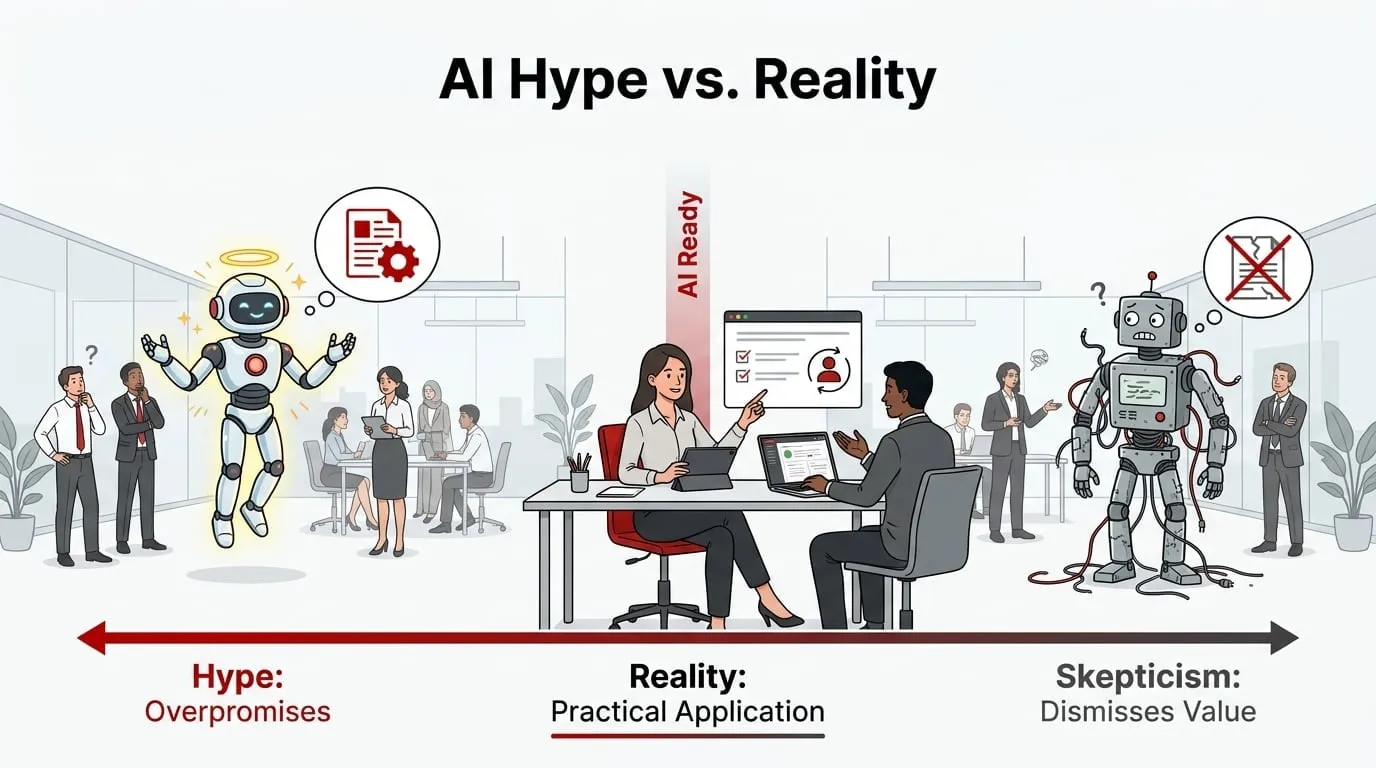
Most AI training treats a hospital director the same as a factory supervisor. That is why it does not stick.
I have watched this play out for years, across more than a thousand organisations. A company decides its people need to be “AI ready.” It buys a course, or builds one. Everyone sits through the same slides: what a large language model is, how to write a prompt, a demo where AI drafts a marketing email. People nod. They pass the quiz. And three weeks later almost nobody is using AI on anything that matters. The training happened. The change did not.
The usual explanation is that people are resistant, or too busy, or need a follow-up session. I do not think that is it. The training did not stick because it was never about their work.
Relevance is the whole game
Think about what those two people in the room actually do.
The hospital director is thinking about patient flow, bed occupancy, staff rostering, which cases to escalate. If AI is going to matter to her, it matters there: helping her spot a discharge bottleneck, or draft a staffing plan, or summarise a stack of incident reports before a board meeting. The factory supervisor lives in a completely different world: shift scheduling, machine downtime, defect rates, safety logs. His useful AI moment looks nothing like hers.
Now show them both the same example, “here is how AI writes a catchy product description”, and you have lost them both. Not because the example is bad, but because neither of them writes product descriptions. They walk out having learned that AI is impressive in the abstract and irrelevant to their Tuesday. That is the exact opposite of AI Ready.
Generic training fails because AI literacy is not a body of facts you transmit. It is a skill you build on your own work, and you can only build it on examples close enough to your work that you can see yourself doing it tomorrow.
Two dimensions, not one
When people try to fix this, they usually reach for one dimension: industry. Healthcare gets healthcare examples, manufacturing gets manufacturing examples. That is better, but it is only half the picture, and it is the less important half.
The bigger divider are functional roles: what you actually do, regardless of sector. A finance leader in a hospital and a finance leader in a factory have far more in common with each other than either has with the nurse or the machinist down the hall. A C-suite leader needs to think about AI in terms of strategy, risk, and where to place bets. A domain specialist needs it for the deep technical task in front of them. A sales or customer-facing person needs it for outreach and client conversations. An operations or compliance person needs it for process and control. Same company, same industry: four different sets of useful AI moments.
So the honest version of “make it relevant” is two dimensions at once: your industry and your role. That is why the AI For Everyone v5 course adapts along both: 25 industries and 6 functional roles. Not as a gimmick, but because that is the resolution at which an example stops being someone else’s and starts being yours. A hospital director sees leadership-level examples set in healthcare. The factory supervisor sees operations-level examples set in manufacturing. Same course, same underlying skills, but each person is learning on work they recognise.
Why generic training feels efficient and is not
Here is the trap organisations fall into. One course for everyone is cheaper to buy, easier to schedule, simpler to report on. It feels efficient. But efficiency measured by how many people sat through it is measuring the wrong thing. If nobody applies it, the cost per person who actually became AI Ready is infinite; you just cannot see it on the invoice.
Personalised training looks more expensive and is actually the cheaper path to the only outcome that counts: people using AI on real work.
The measure isn’t attendance. It’s whether the machinist, the nurse, the accountant each walked away able to point AI at their own next task and know where to trust it.
Start where you stand
There is a second reason generic training misses, beyond examples: it assumes everyone starts from the same place. They do not. Some people in that room already use AI daily and need to go deeper. Some have never opened a chatbot and are quietly anxious. Teaching both groups the same lesson wastes the first group’s time and overwhelms the second.
That is why the sequence matters as much as the content. Before any lesson, you should know where you actually stand, which is the whole point of taking a readiness assessment first, seeing your gaps on a chart, and then having the course spend your time where the gaps are rather than re-teaching what you already know. Relevance is not only what you are shown. It is not being shown what you do not need.
The point
None of this is a technology problem. The models are good enough. The reason AI training does not stick is that we keep teaching it as a subject to be covered instead of a skill to be built on the learner’s own work. Cover the subject and people forget it. Build the skill on their real tasks and it stays, because they have already used it once, on something that mattered to them.
So if your organisation ran AI training and it did not take, do not assume your people were not ready. Ask whether the training ever met them where they actually work. Most of the time, that is the whole story.
The new AI-powered AI For Everyone v5 course on aiready.sg adapts to your industry and role, and starts with a readiness check so it spends your time where your gaps are. It is free for individuals and small teams.